Education is the backbone of every growing society, and teachers play a vital role in shaping the future of students and the nation. The Bachelor of Education (B.Ed.) course is one of the most important professional degrees for candidates who want to build a successful career in teaching and education.
A B.Ed. course helps aspiring teachers develop essential teaching skills, classroom management techniques, subject knowledge, communication ability, and understanding of student psychology. If you are planning to become a teacher in a school, coaching institute, educational organization, or government institution, pursuing a B.Ed. degree can be a strong career step.
Through MultiColleges, students can explore B.Ed. course details, admission guidance, eligibility, syllabus, career scope, colleges, and future opportunities in the education sector.
B.Ed., or Bachelor of Education, is a professional undergraduate-level teacher training course designed for candidates who want to become teachers. The course focuses on both theoretical and practical aspects of teaching. It helps students understand educational philosophy, pedagogy, curriculum development, child psychology, teaching methods, assessment techniques, and classroom practices.
The B.Ed. course prepares candidates to teach at different school levels and handle various academic environments confidently.
A B.Ed. course is suitable for candidates who are passionate about teaching and want to contribute to student development. This course is ideal for those who enjoy working with children or young learners and have an interest in education, communication, learning methods, and curriculum planning.
You should consider pursuing B.Ed. if you:
Want to become a school teacher
Have good communication skills
Are patient and responsible
Enjoy guiding and mentoring students
Want a stable career in the education sector
Are interested in government or private teaching jobs
A B.Ed. degree provides professional training and opens the door to various teaching and education-related career opportunities. It is also an important qualification for many teaching jobs in government and private schools.
Professional Teaching Knowledge:
Students learn modern teaching methods, classroom techniques, and educational theories.
Practical Teaching Experience:
The course includes internships and practical teaching training, which help students gain real classroom experience.
Career Opportunities:
After B.Ed., candidates can apply for teaching jobs in schools, coaching centres, educational institutions, and academic organizations.
Government Job Scope:
B.Ed. is often required for teacher eligibility tests and government school teaching posts.
Career Growth:
After B.Ed., students can pursue higher studies such as M.Ed., Ph.D., or specialized certification courses.
| Particulars | Details |
|---|---|
| Course Name | Bachelor of Education |
| Short Name | B.Ed. |
| Course Level | Professional Undergraduate Course |
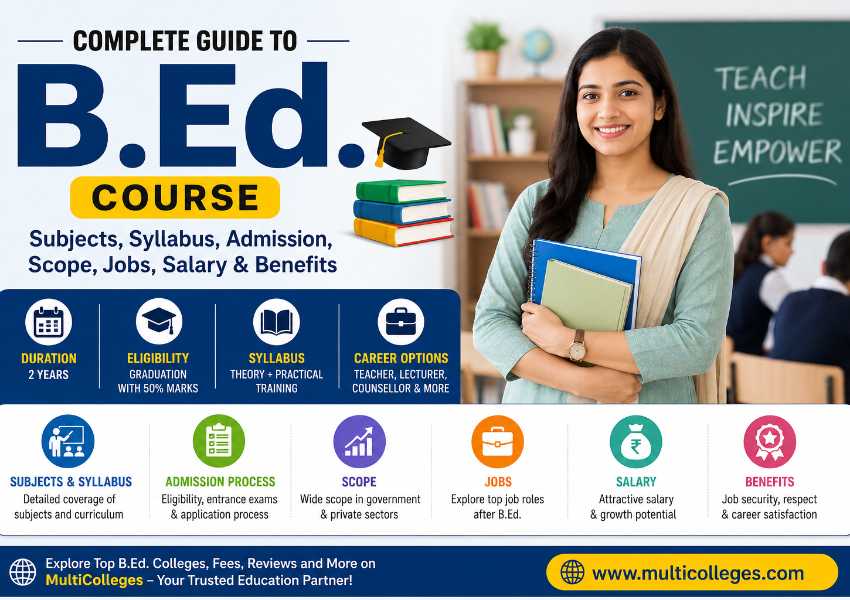
| Duration | Usually 2 years |
| Mode of Study | Full-time, Part-time, Distance, or Online depending on institution |
| Eligibility | Graduation from a recognized university |
| Minimum Marks | Generally 50% marks in graduation |
| Admission Process | Merit-based or entrance exam-based |
| Career Options | Teacher, Lecturer, Education Counsellor, Academic Coordinator, Principal |
| Higher Studies | M.Ed., Ph.D., Special Education Courses |
The B.Ed. syllabus may vary from one university to another, but most colleges follow a similar structure covering education theory, pedagogy, psychology, teaching methods, and practical training.
Philosophical Perspective of Education
Psychological Perspective of Education
Understanding Discipline and Subject – Physical Science
Understanding Discipline and Subject – Biological Science
Understanding Discipline and Subject – Mathematics
Understanding Discipline and Subject – English
Understanding Discipline and Subject – Social Science
Learning and Teaching
Language Across the Curriculum
Knowledge and Curriculum
Gender, School and Society
Educational Technology
Pedagogy of School Subjects
Teaching Methodology of Physical Science
Teaching Methodology of Biological Science
Teaching Methodology of Mathematics
Teaching Methodology of English
Teaching Methodology of Hindi
Teaching Methodology of Social Science
School Internship and Practical Training
Contemporary Indian Society
Yoga Education
Inclusive Education
Guidance and Counselling
Educational Measurement and Evaluation
Educational Administration and Supervision
Assessment for Learning
ICT in Teacher Education
Admission to B.Ed. courses is generally done through merit or entrance examinations. Some universities conduct their own entrance exams, while many states conduct common B.Ed. entrance tests.
To apply for a B.Ed. course, candidates must usually have:
A bachelor’s degree from a recognized university
Minimum 50% marks in graduation
Relaxation in marks may be available for reserved category candidates as per rules
Some institutions may require entrance exam qualification
Common B.Ed. entrance exams may include:
State-level B.Ed. entrance exams
University-level entrance tests
B.Ed. CET
Other institution-specific entrance exams
The general admission process includes:
Search and select suitable B.Ed. colleges.
Check eligibility criteria and admission requirements.
Fill out the online or offline application form.
Submit academic certificates, ID proof, photograph, and other documents.
Pay the application fee.
Appear for entrance exam or counselling if required.
Complete admission formalities after selection.
Students can visit MultiColleges to explore admission-related information and compare education options.
The fee for a B.Ed. course depends on the type of college, university, location, and mode of study.
B.Ed. course fees generally range from INR 20,000 to INR 1,00,000 per year. Government colleges usually have lower fees, while private colleges may charge higher fees.
Students may also need to pay for:
Books and study materials
Examination fees
Practical training
Internship-related expenses
Field visits or workshops
Eligible students may apply for various scholarships depending on their category, academic performance, financial condition, and state government rules.
Scholarship options may include:
Government scholarships
State education scholarships
Merit-based scholarships
Need-based financial assistance
Institutional scholarships
The scope after completing B.Ed. is wide. Graduates can work in schools, coaching centres, colleges, educational consultancies, NGOs, publishing houses, and online learning platforms.
| Level | Job Roles |
|---|---|
| Primary Level | Primary School Teacher |
| Secondary Level | Secondary School Teacher |
| Higher Secondary Level | Subject Teacher |
| Higher Education | Lecturer after further qualification |
| Administration | Principal, Academic Coordinator, Education Administrator |
| Other Roles | Education Counsellor, Content Developer, Curriculum Designer |
After completing B.Ed., candidates can apply for various teaching and non-teaching education sector jobs.
Primary Teacher
Secondary School Teacher
High School Teacher
Private School Teacher
Government School Teacher
Coaching Centre Faculty
Academic Coordinator
Education Counsellor
Curriculum Developer
Educational Content Writer
School Administrator
Principal after experience
B.Ed. graduates can apply for teaching posts in government schools after qualifying the required teacher eligibility tests and recruitment exams. Government teaching jobs are popular because they offer job security, fixed salary, pension benefits, and career stability.
In the private sector, B.Ed. graduates can work in:
Private schools
International schools
Coaching institutes
EdTech companies
Educational consultancies
Online teaching platforms
Curriculum development companies
After completing B.Ed., students can also pursue higher education for better career growth.
Popular options include:
M.Ed.
MA in Education
Ph.D. in Education
Diploma in Special Education
Educational Psychology courses
School Leadership and Administration courses
Salary after B.Ed. depends on experience, location, institution type, subject specialization, and job role.
Fresh B.Ed. graduates may earn around INR 20,000 to INR 35,000 per month in private schools or coaching institutes.
With experience, teachers can earn around INR 35,000 to INR 60,000 per month.
Senior teachers, academic coordinators, principals, and educational consultants may earn INR 70,000 per month or more, depending on institution and experience.
A B.Ed. course offers many long-term benefits for students who want to build a career in education.
Professional teaching qualification
Better job opportunities
Eligibility for school teaching posts
Improved communication and leadership skills
Practical classroom experience
Opportunity to work in government and private sectors
Career stability and respect in society
Scope for higher studies and specialization
The Bachelor of Education (B.Ed.) course is a valuable professional degree for candidates who want to become successful teachers and contribute to the education system. It provides strong knowledge of teaching methods, student psychology, classroom management, curriculum planning, and practical training.
Whether you want to work in a private school, government school, coaching centre, or educational institution, B.Ed. can help you build a rewarding and respected career.
To explore B.Ed. course details, admission guidance, colleges, eligibility, syllabus, and career opportunities, visit MultiColleges and take the next step toward your teaching career.
© 2024 - 2025 All Rights Reserved by Lenstax Solutions Pvt. Ltd.